The Statue of Archangel Gabriel May Return to Heroes' Square Before Year's End
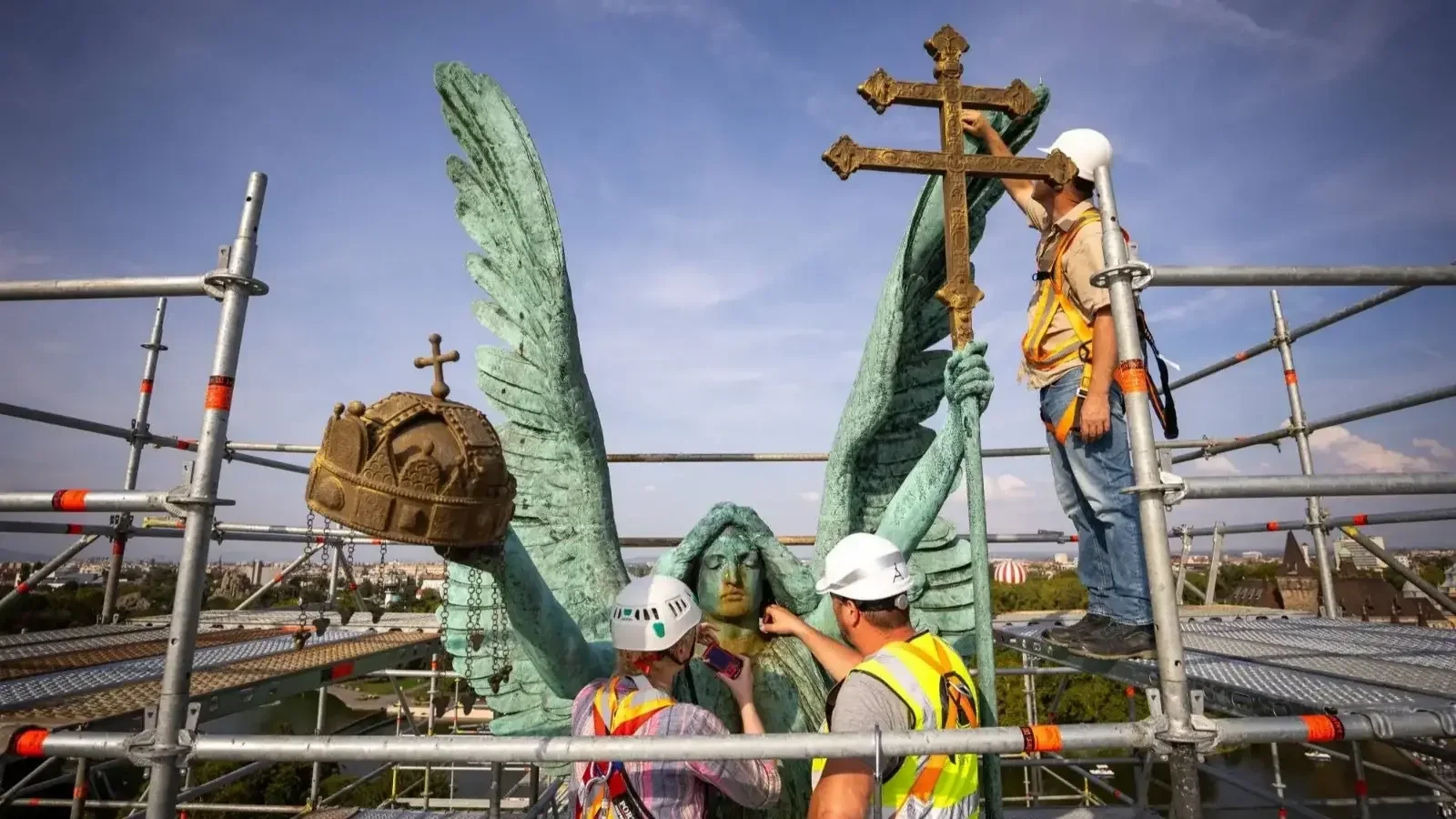 Image source: Mohai Balázs/MTI/MTVA
Translation of an article originally published in Hungarian by Magyar Jelen on March 12, 2026 by Ákos Rácsai.
The comprehensive scientific and restoration assessment of the Archangel Gabriel statue at Heroes' Square has been completed, and according to current plans the statue may be returned to its original location later this year, said Benedek Gyorgyevics, CEO of Városliget Zrt. (the company managing Budapest’s City Park), at a press briefing in Budapest on Thursday presenting the findings, as reported by MTI, the Hungarian state news agency.
The CEO noted that the exhaustive examination of the statue could only be carried out after it had been removed from its pedestal.
The assessments revealed that the artifact had been in a structurally dangerous condition, and that restoring the nearly 30-meter stone column, which has borne the statue for 120 years, had become equally necessary.
Gábor Móczár, Director General of the National Heritage Institute (Nemzeti Örökség Intézete), emphasized that Heroes' Square, as a national memorial site, is one of the most important symbolic sites in Hungarian history. At its center stands the statue of Archangel Gabriel, which is not only an iconic element of the Millennium Monument (Millenniumi emlékmű) but also one of the foremost symbols of Hungarian statehood and Christian tradition.
For that reason, the restoration is not merely the preservation of an artwork, it is the preservation of a symbolic heritage.
The Director General noted that the statue has avoided damage during several historical cataclysms, including World War II and the street fighting of the 1956 Hungarian Revolution, although the passage of time has taken a serious toll on both the statue and the column.
Restoration Could Not Wait Any Longer
The statue, created by sculptor György Zala, was erected in Heroes' Square on October 24, 1901. The roughly 5-meter-tall angel figure, composed of bronze cast elements with a wall thickness of 3–6 millimeters, has stood atop the 36-meter Corinthian column ever since. Although minor refurbishments were carried out over the past decades, these were purely cosmetic and did not affect the statue’s internal structure.
By the early 2020s, several assessments showed that both the statue and the upper section of the Corinthian column were in critical condition, mainly due to rainwater infiltration.
The severity of the deterioration became clear during on-site surveys, when two bronze leaf ornaments, each weighing 20 kilograms, had already shifted from their original mountings.
In the fall of 2024, after preparatory work, the statue was removed in several sections and transported to the restoration workshop of Museum Complex Kft. Based on a series of test cleanings, the team determined that low-pressure dry abrasive blasting using a special surface-protective material was the optimal approach, preserving the statue's patina without damaging the underlying metal.
A Time Capsule Found in the Base
During excavation of the statue’s spherical concrete pedestal, conservators discovered a shattered glass jar with a rolled-up piece of paper and eight metal coins inside.
The time capsule was presumably placed in the pedestal at the monument’s 1901 inauguration and remained undisturbed until 2024.
The paper was recovered in a damp, heavily soiled state, its surface covered in glass shards and concrete particles. Conservators at the Hungarian National Archives (Magyar Nemzeti Levéltár) unrolled the scroll millimeter by millimeter, but no writing was visible to the naked eye.
Using a specialized imaging technique, the original writing was eventually deciphered. The analysis revealed four names: Béla Romy, then a department head at the Prime Minister's Office; Albert Schickedanz, architect of the Millennium Monument; painter and teacher Gyula Aggházy; and Adriaan Willem Weissman, chief architect of Amsterdam, who was present at the statue's inauguration. The text, fragmentary and partially unreadable due to damage to the paper, reads:
“On the twenty-(third) day of October in the year nineteen hundred and one, when the great column of the monument is completed with God's help (…) stone(…) in the presence of the undersigned.”
Related:



Mi a munkánkkal háláljuk meg a megtisztelő figyelmüket és támogatásukat. A Magyarjelen.hu (Magyar Jelen) sem a kormánytól, sem a balliberális, nyíltan globalista ellenzéktől nem függ, ezért mindkét oldalról őszintén tud írni, hírt közölni, oknyomozni, igazságot feltárni.
Támogatás