Mi Hazánk Supporters Must Not Repeat MIÉP's Mistakes, or We Will End Up Just Like in 2002
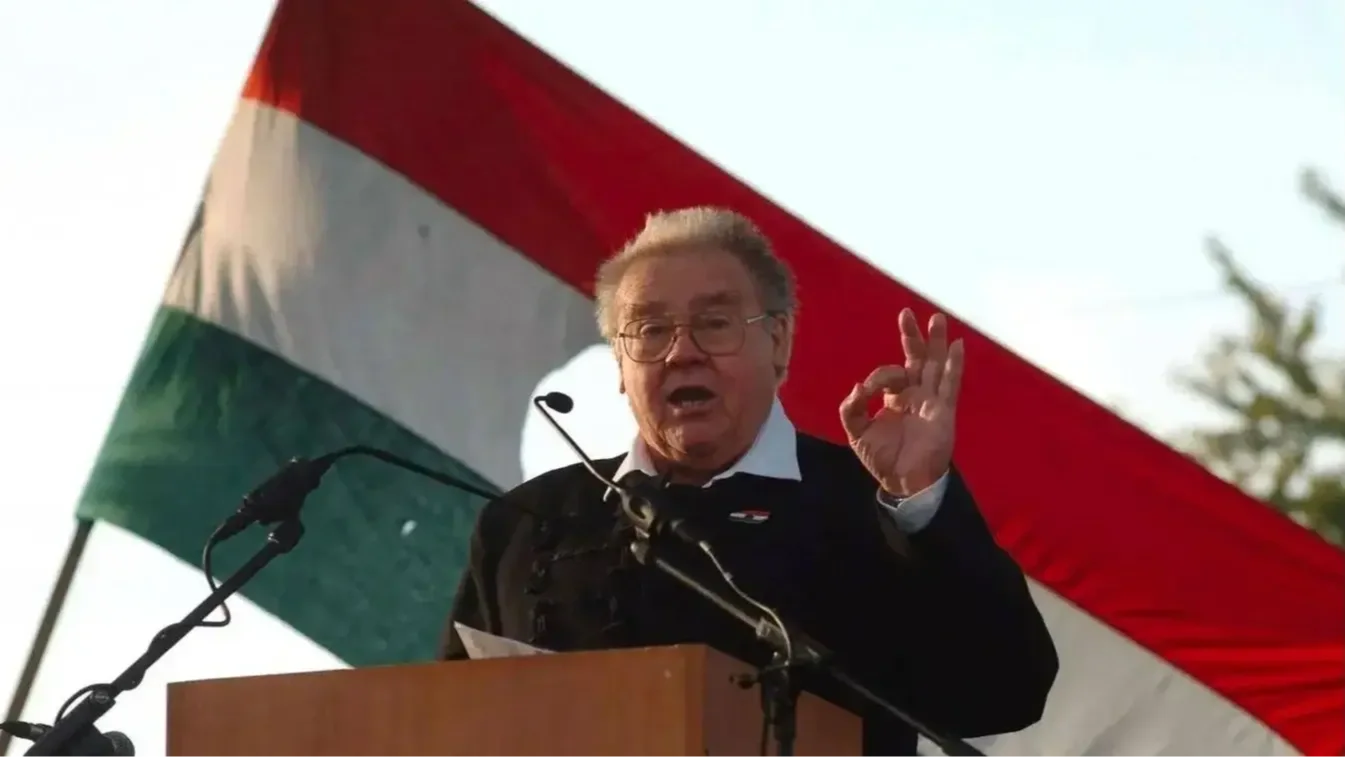 István Csurka - Mediaworks/magyarnemzet.hu
Translation of an article originally published in Hungarian by Magyar Jelen on April 7, 2026 by Erika Vasvári.
In the final stretch before the election, seven or eight public figures respected on the radical nationalist side, pastors and singers, journalists and political activists, called on Mi Hazánk¹ voters to cast their ballots for Fidesz in district races. For the sake of the nation, naturally, because otherwise the nation will be destroyed, they claim. It was exactly this kind of offer that destroyed MIÉP² in 2002, the party and the cause of radical nationalism alike.
The call to switch votes is based on false reasoning, both in principle and in practice. The blackmail behind the appeal goes like this. Whoever refuses is irresponsible, practically a traitor who dooms the nation, while whoever votes for Fidesz, even without conviction, is the one truly serving the nation's advancement.
Radical nationalism already suffered a devastating defeat once, lured by the siren song of Fidesz, and the former MIÉP figures now herding radical nationalist votes toward Fidesz surely remember that.
So why are they calling on us to split our vote? Encouraging this kind of inner division inflicts greater moral damage on the nation as a whole than if voters went to the polls along clear and honest lines.
In the 2002 elections, MIÉP and its leader, István Csurka,³ believed the Fidesz national rhetoric and, driven by a vision of "pragmatic national politics," or, what we might call 1867-style dealmaking⁴ if we want the historical parallel, placed his trust in a Fidesz government that had already spent four years delivering decidedly mixed results.
In 2002, the MIÉP chairman believed that for Fidesz, the national interest stood above all else, just as it did for him. So he made a good-faith offer. MIÉP would withdraw its candidate in a hundred districts in the second round if Fidesz did the same in twenty districts to ensure the victory of MIÉP candidates.
But Fidesz had no intention whatsoever of strengthening the national cause with twenty proven MIÉP representatives.
What it could do, however, was brandish the moral seal of approval that MIÉP had handed it for a hundred Fidesz candidates.
The sobering slap came fast and hard. We as radical nationalists learned that the lesser evil is still evil when the fate of the nation is at stake. For us there is no "somewhat national" easy road, only the rocky road. That certain Third Way of László Németh,⁵ which must be walked with consistency and without compromise.
Here is how István Csurka assessed the Fidesz electoral defeat that also swept MIÉP out of Parliament.
"The Orbán government, when it came to the fateful questions of Hungarian survival, committed the error of remaining trapped in the harmful, dishonest illusions of the Antall government […] It did not dare to pursue a genuinely transformative, fundamentally national Hungarian politics, one willing to bear even the accusation of nationalism."
Csurka concluded that Fidesz was steeped in liberalism, though he counted it as a mitigating factor that Fidesz was "walled in by a Europe-wide, globalist anti-national offensive." But he continued. "Our fault, MIÉP's fault, and personally mine, was that we gave far too much weight to that siege as an excuse on their behalf."
Fidesz is still dancing the same lopsided csárdás dance today. It croons the national lullaby and stomps to a Brussels jig, brandishing its stick but never actually striking.
What has Fidesz actually accomplished in the past sixteen years on the questions of national survival that Csurka identified?
Have we come any closer to national independence, what they now so love to call "sovereignty"?
Economically, certainly not. In agriculture, the concentration of land ownership continues unabated. When it comes to ever-larger estates, we can even speak of foreigners gaining ground, often acquiring Hungarian land through shell companies or EU citizens, because our laws permit it. Soon there will be no Hungarian land left in Hungarian hands. In recent years, according to data from the Hungarian Central Statistical Office, fifty thousand family farms have disappeared. Should we vote for Fidesz so this can continue?
The seizure of Hungarian real estate is also ongoing. The same liberal apparatus that handed productive assets to foreign hands during the post-communist transition is now dispossessing Hungarians of their property.
In the first decade of the 2000s, hundreds of thousands of Hungarians were lured into the trap of foreign-currency mortgage contracts,
and from the 2010s to the present day, the foreclosure and debt-collection mafia has been making Hungarians destitute. There has been no justice. Viktor Orbán said it plainly. If you have the money, go to court and seek restitution. If you don't have the money, then your children can take out a loan at three percent, so that this generation, too, never gets ahead and just keeps paying the banks for life. Should we vote for Fidesz for this?
Or so that we keep tiptoeing through the minefield of a pension system that manufactures internal government debt?
Anyone who has read Mi Hazánk's Virradat [Dawn] Program knows that the current pay-as-you-go pension system is unsustainable.
The pension obligations coming due over the next decade, as masses of people retire, will not be covered by collected contributions.
But the greatest problem is that not enough Hungarian children are being born. The demographic situation has not improved despite tax incentives. In fact, it has worsened. The cause of the demographic catastrophe is not merely a mathematical inevitability, given that the number of women of childbearing age has halved over recent decades, but also the fact that Fidesz never treated family policy and childbearing as a cultural, spiritual, and moral question. Instead, Fidesz has treated childbearing merely as workforce reproduction, subsidized through income-tax policy.
One of MIÉP's first policy proposals was the creation of full-time motherhood as a recognized occupation, paid a respectable salary that would also count toward pension eligibility. In sixteen years of Fidesz governance, this too has gone unrealized.
Csurka's words from 2002 ring just as true for the situation today. Fidesz has not delivered a regime change that truly served the national interest.
A true radical nationalist, therefore, cannot, precisely for the sake of the nation, vote for the continuation of this politics.
Notes for international readers
MIÉP ("Hungarian Justice and Life Party") — A popular Hungarian nationalist party of the 1990s and early 2000s.
István Csurka (1934–2012) — Playwright, essayist, and iconic figure of Hungary's nationalist right. Founded and led MIÉP.
The 1867 Compromise (Kiegyezés) — The political settlement that transformed the Habsburg Empire into the Austro-Hungarian dual monarchy, widely viewed among Hungarian nationalists as a capitulation dressed up as partnership.
László Németh (1901–1975) — A towering 20th-century Hungarian writer and thinker who advocated a distinctly Hungarian path, independent of both Western liberalism and Soviet communism.



Mi a munkánkkal háláljuk meg a megtisztelő figyelmüket és támogatásukat. A Magyarjelen.hu (Magyar Jelen) sem a kormánytól, sem a balliberális, nyíltan globalista ellenzéktől nem függ, ezért mindkét oldalról őszintén tud írni, hírt közölni, oknyomozni, igazságot feltárni.
Támogatás