Had Fidesz Passed Mi Hazánk's 2023 Proposal, There Would Be No Tisza Supermajority Today
 Image source: Peter Magyar's Facebook page
Translation of an article originally published in Hungarian by Magyar Jelen on April 13, 2026 by Tamás Horváth.
A lie has been circulating in Fidesz-aligned media claiming that Tisza's supermajority was Mi Hazánk's doing. In truth, Viktor Orbán and his inner circle have no one but themselves to thank for their historic collapse. Below, we lay out the facts and figures.
Following Sunday's victory by the Tisza Party, the scapegoating went into overdrive across the NER¹ media landscape. Since self-criticism is rarely a strong suit among Fidesz politicians and political pundits, with a few exceptions (such as Orsolya Ferencz), most are hunting for external explanations for the defeat. Some in Fidesz circles are now trying to pin Tisza's supermajority on Mi Hazánk.
At the ballot box, 1+1 is less than 2
The argument goes like this: in several single-member districts, the margin between the winning Tisza candidate and the Fidesz runner-up was smaller than the votes received by the Mi Hazánk candidate, meaning that, had Mi Hazánk stepped aside in those districts, Fidesz would have won and Tisza would have no supermajority. This is simply not true. Electoral arithmetic does not work that way, and especially not between Fidesz and Mi Hazánk.
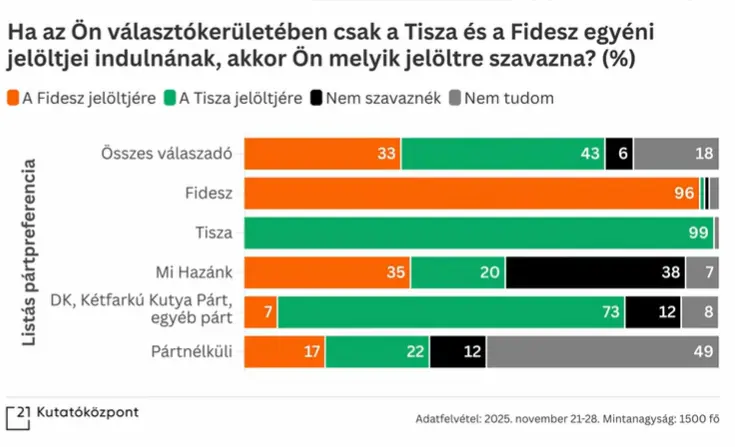
Votes cast for Mi Hazánk’s district candidates cannot be directly added to Fidesz’s total. This is backed up by a November survey from the 21 Research Center,² which found that 38 percent of Mi Hazánk voters would have stayed home entirely if only a Fidesz and a Tisza candidate were on the ballot. 7 percent were undecided; 35 percent would have voted Fidesz; and 20 percent would have voted Tisza.
What does this mean in practice? Take District 13 in Pest County as an example: Tisza candidate Máté Hende received 47.83 percent (24,738 votes); Fidesz candidate László Feldman received 39.15 percent (20,253 votes); and Mi Hazánk candidate Attila László received 11.49 percent (5,945 votes).
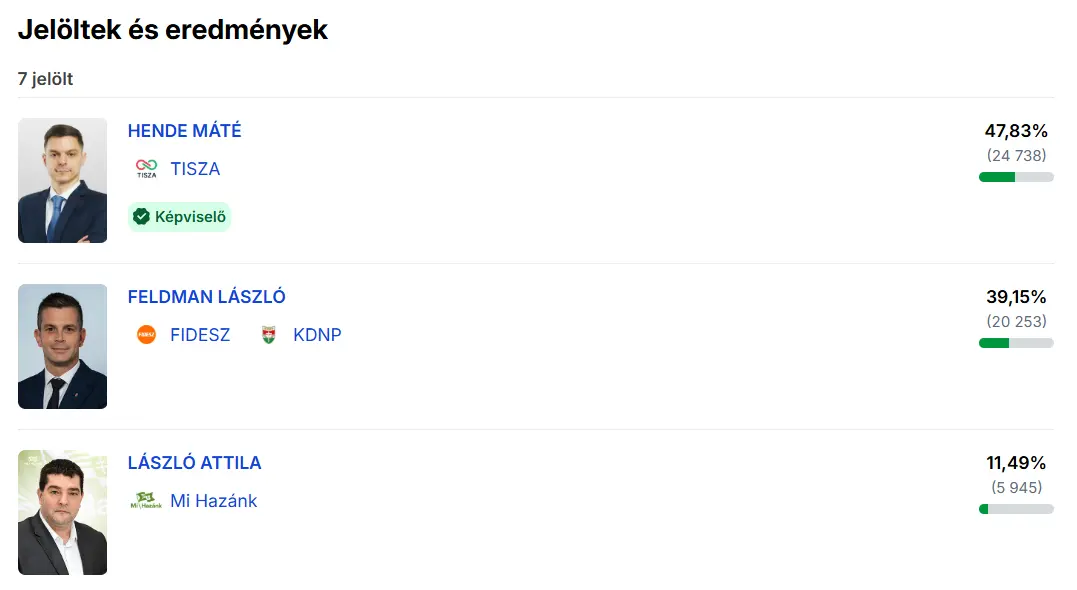
Adding Feldman's and László's totals gives 26,198, on paper more than Hende's 24,738. But as the survey above makes clear, that arithmetic doesn't hold. In reality, Feldman would have captured only 35 percent of László's votes, just 1,783 ballots. That alone would not have been enough to win. Even with those votes, he would have had just 22,036. On top of that, another 1,189 of László's voters (20 percent) would have gone to the Tisza candidate anyway.
In other words, the 4,485-vote gap between the Tisza and Fidesz candidates would have narrowed by a mere 594 votes, not enough to flip the seat, or even to register a meaningful shift in the margin.
The pardons scandal, flaunting and showboating
We don't even need to make a mathematical argument to conclude that Fidesz's total collapse, and the ascent of Péter Magyar and globalist forces, could not have happened without the presidential pardons scandal.³ That was a watershed moment in Hungarian public life, the event that brought Magyar onto the political stage.
The responsibility for the pardons affair rests with Zoltán Balog, Katalin Novák, and Judit Varga, all of them current or former Fidesz politicians.
And let's not forget that Péter Magyar himself emerged from within Fidesz. He was able to land well-paid, no-show positions inside the NER patronage network precisely because of his childhood friendship with Cabinet Affairs Minister Gergely Gulyás and his marriage to Justice Minister Judit Varga.
The pardons scandal, compounded by Fidesz's arrogant and aggressive grip on power, by corruption, nepotism, cronyism, the vulgar display of obscene wealth, and the spectacularly counterproductive use of trashy celebrities it promoted, pushed large numbers of voters past their breaking point. The recklessness of the NER elite delivered a two-thirds parliamentary majority to the globalist, pro-LGBTQ Tisza Party.
Had Fidesz passed Mi Hazánk's bill, there would be no supermajority today
Contrary to Fidesz's talking points, it was not Mi Hazánk that handed Tisza its supermajority. It was László Toroczkai's party that actually tried to prevent any election winner from claiming a constitutional supermajority at around 50 percent of the vote.
And which party voted down Mi Hazánk's proposal for a proportional electoral system? Fidesz.
For those who may not recall: in November 2023, Mi Hazánk submitted a legislative package in parliament that would have restructured both the Budapest City Assembly and the National Assembly in a genuinely proportional way. Fidesz had previously signaled its willingness to support both measures, but ultimately double-crossed Mi Hazánk by passing only the Budapest portion of the package.
Viktor Orbán clearly calculated at the time that the winner-bonus electoral system⁴ would again work in his favor in 2026, and so, driven purely by his naked pursuit of power, he rejected Mi Hazánk's reform. That reform would have introduced a system along the lines of Germany's federal electoral model, distributing parliamentary seats in proportion to each party's actual vote share, so that every party that won enough votes to enter parliament would hold seats that faithfully reflected the will of the voters.
On Sunday night, the tables turned. The Tisza Party converted a 52.44 percent vote share into 136 seats, a two-thirds supermajority in the National Assembly.
Had Mi Hazánk's bill passed in 2023, Tisza would have won roughly 105 seats instead of 136, Fidesz would have held approximately 82 instead of 56, and Mi Hazánk would have secured around 12 instead of 6.
In a 199-seat National Assembly, a supermajority requires 133 seats. Under the reform Mi Hazánk proposed and Fidesz killed, there would be no Tisza supermajority today, and every party that won enough votes to enter parliament would hold seats proportionate to the genuine will of the voters.
With its self-serving power politics, Fidesz betrayed even its own voters, the overwhelming majority of them decent, patriotic Hungarians, and effectively delivered them into the hands of Péter Magyar, a figure built up and effectively puppeteered by globalist forces, and his two-thirds government.
Notes for international readers
¹ NER (Nemzeti Együttműködés Rendszere, or "System of National Cooperation") is the name given to the political and patronage network built around Fidesz during its years in government.
² The 21 Research Center is a Hungarian public opinion research firm.
³ In early 2024, President Novák pardoned a man convicted in connection with a child sexual abuse case. The resulting scandal forced the resignations of both Novák and Justice Minister Varga. Former cabinet minister and pastor Zoltán Balog was accused of having recommended the pardon.
⁴ Hungary's electoral system awards bonus seats to the leading party, delivering significantly more seats than a straight proportional count of its vote share would yield.





Mi a munkánkkal háláljuk meg a megtisztelő figyelmüket és támogatásukat. A Magyarjelen.hu (Magyar Jelen) sem a kormánytól, sem a balliberális, nyíltan globalista ellenzéktől nem függ, ezért mindkét oldalról őszintén tud írni, hírt közölni, oknyomozni, igazságot feltárni.
Támogatás